-
teléfono : +86-592-6382791
-
Email : sales@pidmaxwell.com
teléfono : +86-592-6382791
Email : sales@pidmaxwell.com


En los sistemas industriales de calefacción, los reguladores de potencia trifásicos se han convertido en el elemento principal del control de potencia. Sin embargo, al enfrentarse al proceso de selección, muchos ingenieros todavía tienen dificultades con la pregunta: ¿deben utilizar regulación de voltaje por desplazamiento de fase o regulación de potencia por cruce por cero? Elegir la opción incorrecta puede provocar, en el mejor de los casos, un control de temperatura inestable y, en el peor, afectar la vida útil de la red eléctrica y de los equipos. De hecho, comprender las diferencias subyacentes entre ambas tecnologías aclara la respuesta.
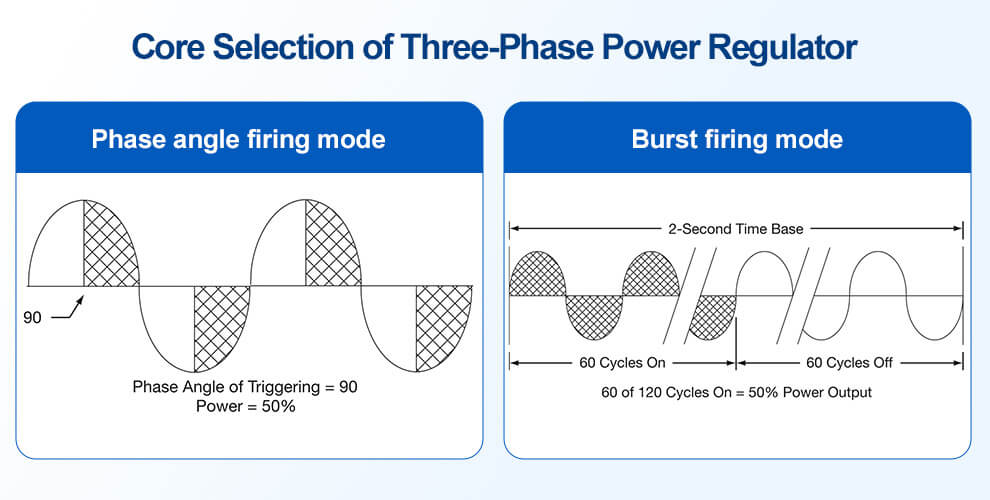
Modo de disparo por ángulo de fase
En esencia, se trata de "recorte de la forma de onda". Se recorta una parte del ángulo de conducción dentro de cada semiciclo, lo que da como resultado una tensión de salida continuamente ajustable. Las ventajas son una respuesta extremadamente rápida y un control preciso, lo que lo hace adecuado para aplicaciones que requieren una respuesta rápida. La contrapartida es la distorsión de la forma de onda, que genera armónicos y causa cierta contaminación en la red eléctrica.
Modo de disparo por ráfagas
Esto se denomina "conmutación de ciclo completo". Determina si se enciende o se apaga en el punto de cruce por cero de la tensión, ajustando la potencia mediante el control del número de ondas sinusoidales completas. Las ventajas son una forma de onda completa, armónicos extremadamente bajos y una calidad de energía muy limpia. La desventaja es que la granularidad del ajuste se da por ciclos, y la velocidad de respuesta es ligeramente más lenta que la del desplazamiento de fase.
En los reguladores de potencia trifásicos, la primera consideración al seleccionar uno es el tipo de carga. Las cargas resistivas (como hornos y controladores de temperatura de moldes) tienen una alta inercia térmica y no requieren una respuesta de alta velocidad; la regulación de potencia por cruce por cero es una opción más fiable: es estable, tiene bajos armónicos y la precisión del control de temperatura es suficiente. Sin embargo, para componentes como barras de carburo de silicio y barras de molibdeno de silicio, cuya resistencia cambia drásticamente con la temperatura, a menudo se utiliza el desplazamiento de fase para un arranque suave durante la fase de inicio, y luego el circuito se cambia de nuevo a cruce por cero después de estabilizarse la temperatura. Esta estrategia híbrida de "primero desplazamiento de fase y luego cruce por cero" protege eficazmente el elemento calefactor.
Las situaciones en las que es necesario el desplazamiento de fase también son claras: primero, en el control primario de transformadores, la conmutación en cruce por cero puede causar saturación del núcleo y corrientes de irrupción; segundo, para cargas con capacidad térmica extremadamente baja (como lámparas infrarrojas), solo la regulación continua por desplazamiento de fase puede seguir los cambios instantáneos.
Por supuesto, muchos reguladores de potencia trifásicos de gama alta ahora admiten control híbrido por desplazamiento de fase y por cruce por cero: utilizan el desplazamiento de fase para un aumento rápido de temperatura durante el arranque y cambian a cruce por cero para mantener la estabilidad a temperatura constante, equilibrando velocidad y calidad. Sin embargo, este cambio requiere un cálculo preciso por parte del controlador; de lo contrario, la corriente de irrupción aún puede causar problemas.
Dejando a un lado los detalles complejos, la selección puede resumirse en cuatro criterios clave:
• Una capacidad de red suficiente y una alta tolerancia a los armónicos permiten mayor flexibilidad en el desplazamiento de fase; por el contrario, el cruce por cero es más seguro.
• El tipo de señal de salida del controlador de temperatura: las señales analógicas se adaptan mejor al desplazamiento de fase, mientras que las señales de contacto son más adecuadas para el cruce por cero.
• Las características de arranque de la carga y la deriva de la resistencia determinan si se necesita un arranque suave o una estrategia híbrida.
• En cuanto al rendimiento global, se deben priorizar los reguladores de potencia trifásicos que admitan control híbrido.
En última instancia, no hay un bien o mal absoluto entre el desplazamiento de fase y el cruce por cero; todo depende de la idoneidad. Para sistemas de calefacción estables sensibles a los armónicos, la regulación de potencia por cruce por cero es una opción prudente. Para ajustes rápidos, transformadores o cargas especiales, la regulación por desplazamiento de fase es la solución correcta. Para líneas de producción de alta calidad, un enfoque de control híbrido puede cubrir ambos aspectos. Comprender la esencia de estos dos métodos de regulación de potencia en reguladores trifásicos hace que la selección sea mucho más sencilla, evitando seguir tendencias a ciegas y la dependencia de caminos establecidos, y garantizando que cada equipo funcione de forma óptima.

dirección : NO.201 Binhuyili, HaiCang district, XiaMen,FuJian, China 361026
Max liao: +8618150368619(whatsapp)
Email : sales@pidmaxwell.com
escanear a través de wechat

Scan to Whatsapp